India Crafters | Artistic - Unique - Carved

Wednesday, 15 February 2012

Religious Sculptures

Figurines are beautiful and religious sculptures even more so, as they are crafted with special care to exude a kind of divinity that you relate to the gods or goddesses. For instance, Buddha statues normally have him in the meditative position with calmness on his face that is unparalleled to any other. Buddha’s teachings have reached far corners of the world today. Many non-Buddhists also have his sculptures at homes or offices for the kind of emotions and peace they evoke in those who see it. These statues are used as decorative centre pieces or even to enhance the beauty of landscaped gardens. While, there is no doubt that this enlightened master has made a difference in millions of lives through his teachings, many stories about him are still unknown. Read on for two of his subtle teachings that can be implementing in our day to day lives.

The Master mostly walked barefoot, and in his long journeys passed many dwellings. Once he was passing through a village. A man approached him and offered some water to drink. Buddha sat under a tree nearby and as he drank the cool water in the summer heat, the village man saw that there were many thorn wounds on the Master’s feet. He asked why he is walking barefoot. The master kept silent with a smile on his face. He then asked Buddha, “Doesn’t it hurt? The wounds do give you pain when you walk, don’t they?” Buddha replied in affirmative, but added, “But even though they do hurt sometimes, I do not suffer. While the hurt is inevitable sometimes, the suffering is by choice.” Upon hearing these deep words the man realized that he was dealing with an enlightened being.

Another story that can be relevant in today’s world is that of Buddha and a hater. It goes something like this:
Buddha was once passing through a village and a man came in front of him and started abusing him. He claimed that the Master’s teachings were useless and that he should stop all this ideas he has about changing the world because he can’t. He told Buddha that he was not welcome and said many other cruel things. All throughout this episode the Master didn’t say anything but intently listened to every word with a serene smile on his face. This irritated the hater even more so, and after saying a lot more he finally stopped talking. Once he was silent Buddha simply asked him if he was finished and whether he could leave and be on his way. The man was taken by surprise. He was stunned and said, “Didn’t you feel bad about all that I said? How can you be so cool and want to just carry on without so much as a word in anger?” To this the Master replied, “In the last village I visited, many people from the village came to meet me with flowers, garlands and other offerings. I simply did not accept them, so they just had to take them back.” The man quickly realized what the Master meant and fell to his feet in remorse.

Religious sculptures like that of Buddha can be quite enriching, if you remember the various teachings when you lay eyes on them.

Sunday, 5 February 2012

Religious Statues

What is the difference between religious statues and any other? Well, every religious statue is about a deity or saint and is symbolic of the teachings. In the sometimes fickle world we live in today, such statues remind us of virtues like righteousness, honesty, wisdom, justice, and many more. One of the recent saints, whose teachings have spread in all corners of the world today, is Saibaba of Shirdi. Revered as one of the greatest saints of all time and worshipped by millions as a God incarnate, Saibaba was a mysterious Fakir who enriched the lives of each person he met in his lifetime. Regardless of religion or creed the enlightened saint blessed all who came to him in myriad ways and preached that there is just one god (Sabka Malik Ek).

Often saying, “my miracles are inscrutable”, Saibaba had demonstrated many miracles in his lifetime. Some of these stories are carried by devotees far and wide. For instance, Saibaba was very fond of burning lamps in the Masjid where he often stayed and other temples in Shirdi and needed oil for the little earthenware lamps he lit. Being a Fakir, he depended on the generosity of the grocers to donate it from time to time, as he lit those lamps every night. There came a time when all the village grocers felt it was unprofitable to give free oil to the saint and one day all of them refused to oblige him saying they were out of fresh stock.

The Fakir returned to his Masjid empty handed, but without a word of protest. He simply poured water into the earthen lamps and lit the wicks. To everyone’s disbelief, the wicks were lit and the lamps burned deep into the night. The news of this miracle seen by many soon reached the grocers’ ears and they all felt profusely sorry about refusing the divine saint. They rushed to his feet and apologized. Saibaba pardoned them but warned them never to lie again. He told them that they could have plainly refused without the untrue excuse that they all made. But, of course by then they all knew that he didn’t need their charity for his task.

The fascinating thing about Saibaba and many of his stories that you can find online or in books, is that they talk of him telling things to particular people and many of these people’s families still reside in Shirdi. His many other wonderous stories have been carried forward through generations. Like that of Babu Kirwandikar’s daughter who often told people she was Saibaba’s sister. Even the godly saint was extremely fond of the child. Once she fell in a well. The villagers rushed to help her and found her suspended mid-air as if some invisible hand was holding her up. The people quickly pulled her out and praised Saibaba for her extended life. Hence, religious statues of Saibaba can be found in every house in Shirdi.

Tuesday, 31 January 2012

Hindu Deity Statues

When looking for Hindu deity statues, especially of goddess Saraswati you must make sure that the statue is beautiful and has the grace that the goddess embodies. After all, according to the Matsya Purana, goddess Saraswati is said to be so enchanting that even the god from whom she evolved fell under her spell and pursued her. The Purana says that the goddess rose from lord Brahma’s mouth and once she realized his intentions, she fled in many different directions. It is said that in whatever directions she ran, the lord developed a head. This is the reason lord Brahma has five heads. The moon and lotus flower associated with goddess Saraswati are considered as eternal symbols of womanhood in Hinduism; hence it is most important that you choose a statue that is feminine and exquisitely crafted.

Another story that comes to mind is of how the goddess saved the world from Lord Shiva’s third eye and complete destruction of life. The tale goes something like this: Lord Shiva was once awakened from his deep meditation. When he looked around, he discovered that the world was on the brink of corruption and people had started being unsalvageable. He was angered and decided it was time to destroy the world and wipe the slate clean. He opened his world destroying third eye and out came a great fire that was so enormous and destructive that it threatened all existence. Everybody, including the gods in heaven started to panic but goddess Saraswati kept her calm. She proclaimed that the lord’s fire can burn only that which is impure and corrupt, and took the form of a colossal river. She then picked up the dreaded fire from the lord’s third eye with her pure waters and within the folds of the river carried it far away from the earth to the bottom of the ocean. Here the fire transformed into a fire breathing mare called Badavagni, the beast that will bring doom to the world. She then wisely foretold that “So long as the world is pure and the man is wise, the terrible Badavagni will remain on the bottom of the sea, far from the world. But when wisdom is abandoned and man corrupts the world, this creature will come out of its resting place and destroy the universe”.

Hence, when buying Hindu deity statues of goddess Saraswati, look for an idol that embodies beauty, wisdom and grace. Also look for symbols that depict the goddess. For instance, it may be wise to look for an idol carrying the musical instrument ‘veena’ in her hands, or sitting on a lotus flower. In some idols the goddess may also be sitting on a peacock.

Thursday, 26 January 2012

Indian Gods Statues

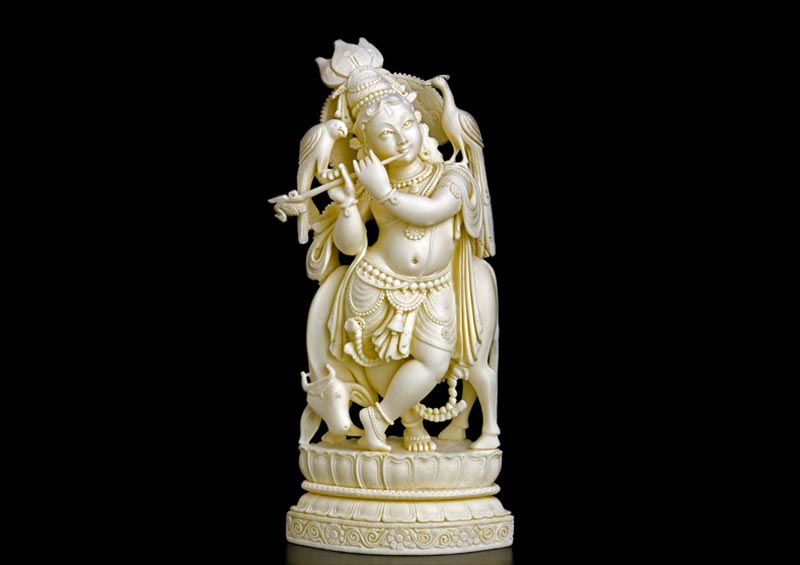
Indian gods’ statues can be easily procured online, but for those of you who do not belong to India or are not Hindus, this can be quite a task considering the fact that there are over a thousand prominent deities worshipped in the religion. A few well-known gods and goddesses are Lord Krishna, Lord Shiva, Lord Ganesh, Lord Rama, Lord Vishnu, Lord Hanuman, Goddess Lakshmi, Goddess Saraswati, Lord Nataraj, and Goddess Durga. Reading up on these gods can give you a much better idea of what they stand for and their significance in this ancient religion. While, you will find that many statues or pictures of the same deity differ from one another in many ways, there are always some similarities that a trained eye can point out. For example, Lord Krishna will always have a peacock feather in his crown.

The peacock feather has more than seven colours within it and it is believed that all these colours signify the lord being the universe itself. The black stands for night, blue for the skies in daylight, gold for the sun, and so on. While, this may be fascinating there is an interesting story of how lord Krishna came to wear peacock feathers on his head. The mythical tale goes something like this.

When one day Krishna woke first from a rest in the forest with his cowherd friends, he decided to wake everyone and call the cows grazing at a distance by playing his flute. Since, the lord was a great flute player, the second his lips touched the wooden instrument, a melodious sound that had a soothing deep rhythm came rushing out of its end. The beautiful music enchanted the peacocks living in and around the hills, and they began to dance and rejoice in the sound of the lord’s melody. The king of the peacocks then came to the lord and thanked him for the divine gesture by touching his feet. Lord Krishna was so pleased with the sight of dancing peacocks and their gratefulness that he too started dancing amongst them. The spectacle was extremely splendid when seen from the top of the Govardhan hills, the heaven and even the netherland. This went on for many days and when all grew tired and eventually stopped, the peacock king came to the lord and said, “You have created a festival of bliss for which we remain eternally indebted. I request you to accept our only opulence, our plumage as a gift. Wear them on your crown as decoration" and dropped many feathers. The lord lovingly accepted the humble offering and wore a few on his crown and continued wearing them since then.

There are many other stories about Lord Krishna and other gods and goddesses. If you are looking for Indian gods’ statues, it may helpful to go through a few to help you decide which statue you want to buy.

Friday, 30 December 2011

Religious Idols

These days there are many of us who have Indian friends and colleagues that we wish to gift something special to, but have no idea what will be appreciated. Knowing of their religious standing or practices is not enough to go out and buy a religious gift, at least for a Hindu. After all, there are more than a 100 million gods that are worshipped in the religion. You might be better off casually asking the recipient what his favorite religious idols are. Chances are you will come across names like Ganpati or Ganesh, Krishna, Saraswati, Shiva, Vishnu, Rama Sita, Natraj, Lakshami, Kali, Bal Gopal, and Balaji. An ideal gift would be to find a beautiful statue and present it on the special occasion. Most religious Hindus love being gifted gods’ idols and statues, to keep in their prayer room or at focus places within the house for decorative purposes.

All the gods and goddesses in Hinduism have legends and stories about them that have been passed down from generation to generation. In fact, if you search the internet, you can find quite a few interesting stories about each of the names mentioned above. One of the most common stories told is about Lord Vishnu and the mighty demon King Bali that made all the gods in heaven apprehensive of the universe’s future. The story goes something like this:

There was once a Demon King named Bali. The king was said to be a true devotee of Lord Vishnu and spent many hours a day in prayer. The Lord was once so pleased with his devotion that he had made him invincible in the battle field as a reward. The King had realized the boon he had been given and started taking undue advantage of this by defeating all gods in battle. All the gods in heaven worried about his growing strength and wondered how he could be distracted or controlled. At last Lord Vishnu came to the rescue, by disguising himself as a common human being in the form of a dwarf Vamana. King Bali was always known as a generous king and prided himself for being so. Hence, when the dwarf asked the mighty king for space which could be covered in three steps, he gladly agreed to oblige against the warning given by his Guru Sukracharya. Soon Vamana grew so large that in one foot he touched the entire Earth, another foot touched the heavens and then King Bali did not have a third foot to provide so he bowed his head to Vamana who then put his third foot on King Bali’s head. However, being worshipped by Mahabali and his ancestor Prahláda, he conceded to them the sovereignty of Patala (netherworld).

Such stories make the various Hindu religious idols all the more appealing. Plus, once you take a look around at the many varieties of statues available in the market, you will be tempted to pick up an idol or two for your own home.

Thursday, 22 December 2011

Hindu Deity Statues

Hindu deity statues are widely available for sale online. All you have to do is find the one that you desire. Since Hinduism is a vast religion and there are millions of recognized deities that are worshipped, this may be a challenging task. The first question you need to ask yourself is regarding the purpose of this buy. If you are looking to procure a deity statue for decorative purposes, you may want to look for beautiful Radha Krishna statues, Ganesh statues, Natraj statues, and the like, which can be found with intricate detailing to make them an ideal center piece for any home. On the other hand, if you are looking for specific gods or goddess for your praying rooms then form of the deity is of crucial importance. For example, there are various forms of Krishna found for sale. These may be Bal Krishna, Krishna as a young man playing his flute, Krishna with Radha by his side, or lord Krishna on a chariot with Arjun.

Lord Krishna is one of the avatars of lord Vishnu. Being the central character in the epic Mahabharata, his life stories are a favorite among children and adults alike. His personality and being was so enchanting and fascinating that even today many believe him to be one of the most complex and intriguing characters among all the Hindu gods. There are many tales of his amorous acts and adventures starting from the time he was born, a young boy killing the great snake Kaliya, a young man flirting with all the young women of the village, to being the king of Dwarka and eventually being a great preacher by quoting the Bhagvad Gita.

One of the best known stories about the lord is about him and a large serpent named Kaliya. It is said that Kaliya and his many snake-wives left their home Ramanaka Dwipa and came to Vrindawan and started dwelling in the river Yamuna. Lord Krishna and his friends were once playing by the river and the ball they were playing with fell into the water. Krishna quickly jumped into the river to retrieve it but the great serpent was disturbed and rose up with his hundred and ten hoods to kill the young boy. On seeing this, Lord Krishna took an even larger form and climbed up to the serpent’s head and started stomping it and dancing on it. Kaliya then started to vomit poison and began to die. Upon seeing this Kaliya’s many wives came near and started pleading Krishna to forgive him and pardon his life. Even Kaliya realized that this was not just any boy, but a form of the Almighty himself, and surrendered, promising to go back home and never return to harm anyone again.

You can even look for Hindu deity statues depicting some interesting story, such as this to grace your home.

Saturday, 17 December 2011

Elephant Statues

Elephant statues are a common sight in many households across different countries of the world. One of the reasons for this may be that there are plenty of similar beliefs associated with the presence of such statues at home or in the workplace. In a majority of cultures it is believed that elephant statues that have the animal’s trunk pointing upwards bring good luck to the home or place where it is kept. Elephants in general have been considered to be mystical and legendary. Considered as a symbol of wisdom, prosperity and power, these sacred and majestic creatures have had their dominance in many Eastern tales and ancient stories.

Today people place elephant statues in their houses as decorative pieces. Beautiful and attractive, elephant statues are loved by children and elders alike. A part of this fondness lies in the many stories one has heard growing up. An old Indian fable, which was later popularized by the celebrated American poet John Godfrey Saxe is one such story many of us have heard. The story is called Six Blind Men and an Elephant.

Once there were six blind Indian men who went to see an elephant. And while each of them was blind, they wanted to touch the elephant and figure out what kind of creature it is. The first man happened to touch the elephant’s side and thought it to be a wall. The second touched only his tusk and concluded that the animal is just like a spear. The third blind man felt the elephant’s trunk and claimed that it was just like a snake, while the fourth man touched the knee and confirmed that the elephant was exactly like a tree. The fifth happened to touch the creature’s ear and concluded that it was like a fan, and the last blind man touched its swinging tail and felt it to be just like a rope. And since each one of them had felt and come to a conclusion, started arguing about their opinion of the animal being accurate, but while they all were partly right they were all wrong.

Another old Indian tale teaches children the evils of being too proud. There was once an elephant swimming in the water. The elephant was very proud of his enormous size and status in the jungle. Seeing his feet dangle beneath the water, an alligator caught his limb and started pulling him into the depths. The elephant then realized that his size was of no use and started to pray to the almighty to help him escape. God then appeared and set him free of the alligator’s clasp.

Such colourful tales and all the other myths and beliefs associated with elephant statues, make them very popular with people even today.

Wednesday, 7 December 2011

Indian Gods Statues

Hinduism is one of the oldest religions in history. While Hindus are believed to have 330 million gods, all devotees believe that there is only one almighty God. This concept may be hard to understand for some. Maybe the following example might be of assistance to shed some light on this idea. Think of a tree that is huge and wide spread. Now if the tree was the ultimate God, the almighty, then its many branches can be said to be the millions of gods worshipped by Hindus. And the leaves can be thought of as the different Avatars or manifestations of the various gods and goddesses. In view of the fact that there are so many gods and goddesses, and that Hindus believe in idol worship, you can come across a wide variety of Indian gods’ statues for sale at online stores.

Some of the most popularly celebrated deities in Hinduism are Lord Ganesha, Lord Shiva, Goddess Durga, Lord Hanuman, Lord Rama, Lord Krishna, Lord Vishnu, Goddess Saraswati, Goddess Lakshami and Lord Shani. Every god is worshipped and praised for his characteristics and legendary life incidences. If we talk about Lord Ram; his characteristics which stood him apart were morality and virtue. These traits made him an ideal son and king of his time. While many have heard of the epic, Ramayana, only a few have read the Sanskrit book that may be considered to be the life story and principal scripture about Lord Rama. Ramayana was written by saint Valmiki and is considered as one of the important epics in the religion.

Lord Rama is also known as Shri Ram, Ramachandra and Maryada Purushottama and believed to be the seventh avatar of Lord Vishnu. This king of Ayodhya’s names has specific meanings that are metaphoric representations of his many characteristics. Ramachandra literally means Rama like the full moon in all its glory. On the other hand Maryada Purushottama translates into being the epitome of righteousness. Lord Rama is also recognized in Jainism as one of the nine, white Balas. Commonly chanted mantras of Rama are ‘Ram Naam Satya Hai’ and ‘Shri Ram Jai Ram Jai Jai Ram’. The mantra, ‘Ram Naam Satya Hai’ is chanted by Hindus from all over the world while carrying a dead body to be cremated. This is done so to imply that the body which can no longer say the lord’s name is of no value to the living world and hence is to be reduced to ashes.

There are many short stories about Lord Rama that aspire the devotees to live righteously and on the path of truth at all times. You can find Lord Rama or other Indian gods statues in most Hindu homes. And while you may belong to another religion, it may be interesting to realize how all the religious teaching and implications point towards that one Almighty God.

Indian Gods’ Statues

Hinduism is one of the oldest religions in history. While Hindus are believed to have 330 million gods, all devotees believe that there is only one almighty God. This concept may be hard to understand for some. Maybe the following example might be of assistance to shed some light on this idea. Think of a tree that is huge and wide spread. Now if the tree was the ultimate God, the almighty, then its many branches can be said to be the millions of gods worshipped by Hindus. And the leaves can be thought of as the different Avatars or manifestations of the various gods and goddesses. In view of the fact that there are so many gods and goddesses, and that Hindus believe in idol worship, you can come across a wide variety of Indian gods’ statues for sale at online stores.

Some of the most popularly celebrated deities in Hinduism are Lord Ganesha, Lord Shiva, Goddess Durga, Lord Hanuman, Lord Rama, Lord Krishna, Lord Vishnu, Goddess Saraswati, Goddess Lakshami and Lord Shani. Every god is worshipped and praised for his characteristics and legendary life incidences. If we talk about Lord Ram; his characteristics which stood him apart were morality and virtue. These traits made him an ideal son and king of his time. While many have heard of the epic, Ramayana, only a few have read the Sanskrit book that may be considered to be the life story and principal scripture about Lord Rama. Ramayana was written by saint Valmiki and is considered as one of the important epics in the religion.

Lord Rama is also known as Shri Ram, Ramachandra and Maryada Purushottama and believed to be the seventh avatar of Lord Vishnu. This king of Ayodhya’s names has specific meanings that are metaphoric representations of his many characteristics. Ramachandra literally means Rama like the full moon in all its glory. On the other hand Maryada Purushottama translates into being the epitome of righteousness. Lord Rama is also recognized in Jainism as one of the nine, white Balas. Commonly chanted mantras of Rama are ‘Ram Naam Satya Hai’ and ‘Shri Ram Jai Ram Jai Jai Ram’. The mantra, ‘Ram Naam Satya Hai’ is chanted by Hindus from all over the world while carrying a dead body to be cremated. This is done so to imply that the body which can no longer say the lord’s name is of no value to the living world and hence is to be reduced to ashes.

There are many short stories about Lord Rama that aspire the devotees to live righteously and on the path of truth at all times. You can find Lord Rama or other Indian gods statues in most Hindu homes. And while you may belong to another religion, it may be interesting to realize how all the religious teaching and implications point towards that one Almighty God.

Wednesday, 30 November 2011

Ganesh Statues

Ganesh Statues are a fairly common sight all around the world. The Elephant God, as he is known in the western countries has fascinated people across the globe with his obvious elephant face, large tummy and tiny mouse. This Hindu god is invoked at the beginning of all traditional rituals and is worshipped in thirty two different forms recognized in the Agamic scriptures.

The 32 names of Ganesh are Baala Ganesh, Dharuna Ganesh, Bhakti Ganesh, Veera Ganesh, Shakti Ganesh, Dwija Ganesh, Siddhi Ganesh, Ucchishta Ganesh, Vigna Ganesh, Kshipra Ganesh, Heramba Ganesh, Lakshmi Ganesh, Makara Ganesh, Vijaya Ganesh, Nritta Ganesh, Urdhva Ganesh, Vara Ganesh, Ekakshara Ganesh, Dhryakshara Ganesh, Kshipraprasaada Ganesh, Haridra Ganesh, Ekadhanta Ganesh, Srishti Ganesh, Utthanda Ganapati, Ranamochana Ganesh, Dundi Ganapati, Dwimukha Ganesh, Trimukha Ganesh, Simha Ganapati, Yoga Ganapati, Durga Ganesh, and Sankatahara Ganapati.

Lord Ganesh also has quite a few names that he is called by such as Ganapati, Ganesha, Ekadantaa, Chaturbhuj, Amit, Kapila, Krti, and so on. His hundred and eight names are symbolic of his various characteristics, blessings, legends attached to his godliness and praises by his worshippers.

Ganesh is known as the eldest son of Lord Shiva and Goddess Parvati. There is a fascinating story about this in the Ganesh Khanda of the Brahma Vivarta Puraan. The story goes something like this. Lord Shiva and Goddess Paravti were gifted the magical Wisdom Fruit which held the nectar of immortality and supreme knowledge and they wanted to bestow it on one of their sons which were Lord Ganesh and Lord Kartikeya (Subramanya). Unable to decide Lord Shiva thought for a bit and suggested that they have a race. He said that whoever went around the whole world three times and came back first to the starting point first would be the winner and get the magical fruit. Upon hearing this Lord Kartikeya flew away on his peacock hastily to take a round of the world, quite confident because his brother was slower and fatter; while Lord Ganesh simply walked around Shiva and Parvati and encircled them three times and asked for the prize of his success. Lord Shiva told him that he had not gone around the world, but Ganesha lovingly replied saying, “No, but I have gone around my parents. My parents represent the entire manifested universe!” And upon hearing this Lord Shiva decided Ganesh to be the winner and the tales of his wisdom and intellect abound to this day.

There are many stories of this Hindu god. In fact each name and form of Lord Ganesh has a story behind it. Different Ganesh statues too represent some or the other form of the lord. Reading up on some stories might be a good way to get an insight into such Hindu gods.

Monday, 28 November 2011

Hindu Deities Statues

All Hindu deities’ statues represent one or more particular aspects of the Supreme Being. And while Hindus worship many gods and goddesses, they believe that all these are forms of that one Supreme God. For this reason, it can be said that Hinduism is not just Polytheism, but a Monotheistic Polytheism. One of the celebrated goddesses in Hinduism is goddess Lakshmi. Believed to be the goddess of wealth, fortune, power, fertility, luxury and beauty, the deity promises material and spiritual fulfillment to her worshippers. Some of the many names of this goddess are Padma, Padmahasta, Bhargavi, Sridevi, Bhumi Devi, Chanchala, Indira, Ramaa Devi, Shri, Vaishnavi, Mahalaxmi, Jalaja, Aishwarya, Roma, and Padmamaladhara Devi.

This wife of Vishnu is associated with blessing the worshippers with eight types of wealth. These are Adi Lakshmi, Dhanya Lakshmi (granary wealth), Dhairya Lakshmi (wealth of courage), Gaja Lakshmi (elephant as the symbol of wealth), Santana Lakshmi (wealth of progeny), Vijaya Lakshmi (wealth of victory), Vidya Lakshmi (wealth of knowledge) and Dhana Lakshmi (monetary wealth). Statues of the goddess are depicted in a female form with four arms. She is mostly dressed in red hues with golden borders and gold jewelry. Carrying gold coins and lotuses in her hand, she is also standing on a large lotus or sitting on an owl (Ulooka) or celestial turtle. There are two elephants standing next to the goddess’s figure.

The two elephants stand for the name and fame associated with wealth, while the colour red is symbolic of activity and hard work. The four arms represent the four directions and the presence of god. The donned gold linings on the sari and jewelry denote prosperity, and the lotus the goddess stands on is symbolic of not being too attached to materialistic things like monetary wealth, just like the lotus flower that calmly floats on the surface of water but does not get wet. The deity Lakshmi’s hands too signify a great deal. The hands towards the front are symbolic of the physical world and the work that needs to be put in, in order to achieve the goals in life. The other two hands indicate the spiritual activity one must not forget to do in order to live a complete life.

Hindu Deities statues like Lakshmi idols are prayed to and kept in most homes. The goddess is especially worshipped during the festival of lights, Diwali. This daughter of the Sea is said to be the power and Maya of Lord Vishnu, who is the preserver of the world. This is the reason that some idols of Vishnu have two forms of Lakshmi. These are Sridevi, which is the goddess of wealth and knowledge, and Bhudevi, which is the mother form of the goddess.

Wednesday, 16 November 2011

Hinduism Statues

Hinduism statues are three dimensional sculptures of Hindu gods and goddesses. In view of the fact that symbolism is a great part of this religion, you may notice that deities are represented carrying weapons, atop various animals or birds, holding particular flowers, having multiple hands or heads, etc. While many of you may not know the significance of such aspects in the sculpted figure, all such facets stand for various attributes the god or goddess embodies. For instance, the lotus flower is considered to be the symbol of auspiciousness, beauty and truth. Therefore, Hindu deities who carry or are presented seated on a lotus are said to possess such qualities in their mythological being or personality, such as Goddess Saraswati, Goddess Laxmi, Lord Bramha, Lord Vishnu, etc.

The Hindu religion is believed to have 33,00,00,000 deities, and this may be the reason why it is quite confusing for people from all over the world to identify one from another, without the use of symbols that represent them. Non-Hindus as well as foreigners may be able to recognize lord Ganesh because no other god in Hinduism has an elephant’s head or a mouse as his mode of transportation. They may call him by many names like Ganpati, Gajanana or even the Elephant God, but they refer to the same deity.

If you are looking to buy a deity statue for your home, it may be wise to look for the perfect piece online. You may come across quite a few dealers and manufacturers that sell such sculptures in a variety of sizes; but before doing all that you need to be sure of what god or goddess you are procuring. While most companies are reliable, it is advisable to have a basic knowledge of the god or goddess and their prominent symbols to make your hunt worthwhile. After spending a considering amount of money and time you want the statue to be perfect and have all the attributes of that deity.

Lord Shiva can be identified as a male figure carrying a trident. On the other hand, Lord Vishnu is bound to be carrying a discus, while his incarnation Lord Krishna can be recognized by the lovely peacock feather in his crown. Just like the weapons or embellishments can help you identify the deities, so can their means of transportation, namely the different birds and animals. For example, the bull is lord Shiva’s companion in travel, while Vishnu rests on a great big serpent but travels on a giant eagle. Even the various creatures used as vehicles (vahanas) by the gods are symbolic.

Hinduism Statues are full of mystery and allure, not to mention great beauty. So, start your search for the ideal statue only after you truly know which deity you want to welcome into your home.

Thursday, 10 November 2011

Indian God Statues

In the holy book of Hinduism called the Bhagavad Gita, it is written that ‘even those who worship other gods, ancestral deities, elemental powers, if they do so with complete faith, then their faith is justified, for the Divine accepts every form conceived by the worshipper’. It is a pleasant fact that if you are out looking for Indian God Statues, you may come across a whole wide range of them on the Internet. Some of the popular ones are those of Hindu deities like Lord Ganesh, Lord Krishna, Goddess Saraswati, Goddess Durga, and saints such as Saibaba, Mahavir, Swami Samartha, etc.

Despite the fact that such statues are available at different locations throughout the country, and finding a statue of your choice is not too hard a task, a majority of people are turning to Internet shopping and online hunts for the perfect Indian gods’ statues. There are quite a few advantages of going online instead of personally taking a trip to the marketplace and finding a sculpture or artisan or shop that sells such products. Plus, there is always a limited choice when it comes to just one or two stores. Online shopping on the other hand is a whole different ball game. Not only does this method save you time and effort, but also gives you the freedom to shop on your own time, any hour of day or night. Plus with so many dealers of statues online, you can be sure of getting a wealth of variety regarding choice in materials, designs, gods, styles, work, carvings, etc., providing complete value for money.

Seeing that Hindu gods and goddesses statues can come in a plenty of diverse forms, it is crucial for you to know exactly what you are looking for. First of all you must decide on the god you want to purchase. Here, let us assume that you want to buy a statue of Lord Krishna. The next step would be to search for companies that make and sell Krishna statues. Once you have shortlisted a few companies that fit your criteria for standard and quality, you can go through the pictures of different statues to find one that you like. To make this process even simpler you can even decide on a particular form or aspect of the selected god as well. For example, choose whether you want to buy a Krishna statue that has him in his warrior – poet form, as a mischievous child, as a young man, or with Radha.

No matter what form or god you desire to own, you can be sure that the best place to look for Indian gods statues is on the Internet, thanks to reputable and reliable statue dealers.

Friday, 4 November 2011

Religious Sculptures & Indian Statues

Religious sculptures have been an integral part of Indian lifestyle and history. In the olden times a large number of such sculptures were only created for communal temples, the elite and the state’s royal families. In the present day on the other hand, religious Indian statues can be readily bought by anyone who desires their beauty. You can find a wide range of statues in a variety of sizes, designs, and materials of most of the prominent religious deities in the market. If you are unable to acquire exactly what you want or live out of India and no way of finding a shop that sells such sculptures, you can always rely on the Internet to hunt for the statue of the precise deity that you want.

Finding statues and sculptures of religious significance is a fairly easy task, thanks to the many small and big companies present online that deal in supplying such sculptures all across the world. These companies have beautiful and elaborate websites that provide all the needed information about the statues as well as the deities or saints. The products are effectively marketed by beautiful high definition photographs, and mention of the exact dimensions of the figure as well as material used to make the statue and its required maintenance. All these features make this kind of online shopping easy and effortless. Another marked benefit of buying the statue you want online, is the kind of choices that are present online. You have the advantage of selecting the material, size, design, etc, from an unending selection from various companies.

Many of you may feel reluctant to use their credit card and shop online, but if you deal with a reputed and reliable company, this becomes a non-issue. It is advisable that when you go through the website, look for an assurance for secure and safe money transaction. It may be wise to even check out a few testimonials or blogs on the site to get a better idea of what you are ordering. Such Indian statues are making for popular gifts nowadays. They are intricately carved and look exceedingly exquisite and beautiful. While a majority prefers to use religious idols as a part of their praying rituals, there is an increase in the number of people who buy such sculptures as part of the décor.

Religious sculptures and Indian statues are no longer only spotted at homes and offices; today such carved figures are also gracing the best hotels, lounges, and recreational buildings of the world as center pieces. It cannot be denied that such idols add their special elegance and unique attractiveness to any setting. So why wait to get your hands on the sculpture of your choice? Start browsing now!

Saturday, 22 October 2011

Elephant Tusk Statues

Elephant tusks have been considered lucky in many cultures. In India, during the British rule, hunting elephants for their tusks was a fairly common phenomenon. The hunters were mostly royalty or British officials who would then keep the tusks as decorative items in their palaces, homes or offices. Although, in today’s times hunting of elephants is strictly forbidden by law and consequences for such actions can be quite severe, the love for Ivory or elephant tusk statues has not yet died down. Having said this, the many variety of faux-ivory or imitation elephant tusk statues available in the market today have made things easy for the many lovers of beauty, who no longer have to be disappointed at not owning this item.

To get your hands on a beautiful set of elephant tusk statues, you can try and find a reliable and reputed dealer on the Internet. You may come across quite a few websites that make sculptures of various Indian deities like Lord Ganesha, Lord Krishna, Goddess Saraswati, Goddess Laxmi and others, in addition to making elephant tusk statues. The reason for this is that while some people like to buy these tusk sets as gifts or to decorate their homes with a stunning focus piece, some buyers use these as pieces kept on the side of statues of deities that they pray to. No matter what the utility, it cannot be denied that these particular sets add a special touch of elegance and exclusivity to each setting.

It is a fact that resources like online shopping have made procurement of items like elephant statues or tusk statues an extremely easy task you can undertake from the comforts of your home. However, buying something in a hurry and realizing the size is not right or that there are betters deals or pieces out in the market and you settled for a bad deal can upset anyone. That's why the one thing you must know is the size of the tusks you want to buy. An ideal size for such an item to be kept in a home or office space is about 35 to 40 inches with a widest point of approximately 3 to 4 inches. Browsing through the many websites is the answer to finding the best deal, but it is crucial that you find a balance between what the price is and what you are getting for that price-tag. Many companies may offer great prices, but are unreliable when it comes to quality of the product.

Rather than procuring something cheap, it is best to first shortlist your favorite elephant tusk statues and then compare prices and quality, materials used to make them, reputation of the company, security in money transaction, etc. You could also take a look at some beautiful elephant statues while browsing.

Thursday, 13 October 2011

Significance of a Durga Statue

Hinduism is a complex religion and so are the deities in their numerous forms. It can be hard to understand the wholeness of a particular god or goddess by simply seeing their statue; as the statues are sculptured depicting a particular legend or expression or avatar of the deity. Even a Durga statue that you come across on one website may differ in form, expression, and details from another statue you see on a different website store. If you are looking to buy a detailed statue of this goddess believed to be the one who can redeem in situations of greatest distress, a good place to find one that is beautiful and fits your budget would be online.

If you browse the Internet for statues of Durga, you may hit upon a number of websites that make them in a variety of materials and sizes. There are statues carved out of stones, made from metals, FRP, glass, ceramic, etc, which come in a variety of sizes. As mentioned earlier, all goddesses in Hinduism come in many forms and expressions, and before you buy a statue of this ‘invincible’ goddess it might be wise to know a few aspects of her being.

A manifestation of Devi, who is believed to be the female cosmic force and energy that sustains and supports the world that we live in, Durga is endowed with a number of characteristics that are distinctive. She is the self-sufficient, fierce, compassionate and destructive form of Shakti. In India, there is a festival known as Navratri that is celebrated each year to praise this goddess. Navratri literally means nine nights and is celebrated by traditional dancing in the nights, citing of religious texts to invoke the goddess, sowing of seeds and watching them sprout and grow.

There are said to be nine characteristic forms of Durga, which are worshipped one form per day in the nine days of Navratri. They are Shailaputri, where she is two-armed, carries a trident and lotus flower, and sits on nandi, the bull; Brahmacharini, where she is two-armed carrying a rosary and pot; Chandrakhanda is the form in which Durga is atop a tiger and has ten arms out of which eight arms carries a bow, arrow, sword, mace, trident, pot, rosary, lotus and remaining two arms shows Varada & Abhaya mudra; Kushmanda, where she is eight-armed with a tiger by her side. In this form she carries a pot, holy water, bow, arrow, lotus, discus, rosary and a mace. In this form Ma Durga creates solar system; Skanda Mata is the form where Ma Durga rides a lion and has four arms carrying infant Lord Kartikeya or Skanda, lotus in two of her arms and one arm raised in blessing posture; Katyayani is the form which showcases her atop a lion with four arms. Two arms carry a sword & lotus and other two shows Varada & Abhaya mudra; Kalaratri is the form also known as Kali. Here the goddess has four arms and rides a donkey. While dark and unattractive in appearance, she has one hand blessing devotees and depicts that everything has a dark side as well; Mahagauri wears white, rides a bull or a white elephant and is four-armed carrying a trident and hand-drum, she is presented as purity itself; and Siddhidayini is the ninth form of Durga in which she is four-armed and sitting on a lotus.

You can choose a Durga Statue that presents her in any of these nine primary forms. All you have to do is look for a piece that is beautiful and illustrated in details like weapons and facial features of the goddess.

Wednesday, 5 October 2011

Religious Statues and Sculptures

To look for exclusive and beautiful religious statues and sculptures for decorative or spiritual purposes can be challenging. You may find such statues made in precious metals like gold and silver at Indian jewelry stores, but coming across some in materials other than metals, such as fiber reinforced plastic (FRP), resin, wood or stone is slightly more difficult. In situations such as these, resources like the Internet come handy. You can hit upon a number of websites that are dedicated to showcasing different types of statues and sculptures made by the owner company, by simply searching for your requirement on any web search engine. Different companies sell different products, therefore it is best to know exactly what you are looking for and if not, have plenty of time to browse around and shortlist items you like.

Indian mythology showcases the various deities in a wide range of moods, names and expressions, hence statues made to capture their essence can be found in a variety of styles and designs. There are many options when it comes to religious statues and sculpture, but some of the most popular are intricately designed statues of Lord Krishna, Lord Ganesha, Goddess Laxmi, Goddess Saraswati, Saibaba, Jalaram, Ram – Sita, Shakuntala, Parshvanath, and Shreenathji. The statues come in various sizes, not to mention the differences in postures and expressions in different statues.

For instance, Lord Ganesha may be in a standing posture, sitting on his royal throne, or lying down. On the other hand goddess Saraswati is always sitting, but the statue may be elaborately carved or simply made to show her elegantly sitting on a lotus with a sitar in her hand. Another example could be of Lord Krishna, who is an expression or Avatar of one of the greater gods, Vishnu. In India you may notice that Krishna is also known as Kishan Bhagwan, Murlidhar, Shreenathji, Vasudeva, Gopala, Jagannatha, and Vithoba. You may find many different statues of Krishna in the market, which capture poses from his countless legendary stories. Gopala or Bal Krishna are statues of Krishna as a child, while Shreenathji is a Rajasthani interpretation of the God with him wearing a traditional Rajasthani outfit. On the other hand, other statues of Krishna may have him playing the flute leaning on a cow, standing alone playing the flute or with Radha next to him.

The variety of religious statues and sculptures you may chance upon in the market is amazing. You can always count on finding the perfect statue of your deity or saint, if you take a little time and browse through a few websites. All you have to do is have a material in mind, and know a range in size that you prefer.

Tuesday, 20 September 2011

Indian Gods Statues

Sri Ramakrishna Paramahansa, one of the principal teachers of Swami Vivekananda once said, “Many are the names of God and infinite the forms through which He may be approached.” In Hinduism one of the most dominant forms of praise and worship is idolism. Indian gods’ statues can be found in most homes, offices, even cars. Indians living in a number of different countries have embraced this approach to in a way preserve their belief and faith in the higher power. With oriental religions like Hinduism, Taoism and Buddhism gaining popularity throughout the world, various statues of gods and goddesses are not only being procured for worship, but also as a means to add a special touch to the décor.

There are a wide variety of sculptures available in the market today. If you are not a resident of India, you may want to search for dealers and statue makers listed on the Internet for your procurement needs. With a large number of online dealers that are committed to supplying products that are made using top grade materials and are high in quality, buying such religious statues online is a great idea. Not only does this save you time and effort of looking for a shop or company in close proximity to your city, but it also gives you the flexibility to take your time in making the right choices in terms of what you want, and provides ample convenience as most items are delivered to your doorstep if need be.

All you have to do is choose the figure you most desire. You can choose from a variety of different statues of Lord Shiva, Lord Ganesha, Lord Krishna, Goddess Parvati, Goddess Saraswati, Goddess Lakshmi, etc. You can also find statues of Shreenathji, Jain saint Parshvanath, Shakuntala, Saibaba, Ram Sita, Ram Darbar, Jalaram, and the like. Most of these statues come in small or medium sizes and in a wide range of materials like brass, fiberglass, silver, wood, ceramic, glass, etc. These statues are durable in addition to being finely carved and amazingly beautiful. Since Indian artisans are known for their delicate and intricate carvings, for the most part this beauty is what you will be paying for. The minute details on the many statues are what bring the mere piece to life.

So, the next time you are out shopping for Indian gods’ statues keep a few things in mind. Remember that you are paying the premium for its beauty not material used, so look for a detailed piece that exudes exquisiteness. Also, buy a statue with its purpose in mind. If you are going to use it as a decorative piece, the size and style should go with your home’s décor. Lastly, acquire the statue from a reputed source as this ensures a good quality product.

Wednesday, 14 September 2011

Statues of Ganesh

The God of wisdom, attainment and prosperity, Ganpati or Ganesha is in all probability one of the most loved and worshipped deities in Hinduism. In fact, there is a ten-day festival celebrated in India, Nepal, and by Hindus living in the United States, Canada, Fiji, Singapore, etc., starting on Ganesh Chaturthi and ending on Anant Chaturdashi. This festival marks the birth of Lord Ganesh as one of the superior gods. The beloved elephant-headed God is believed to bestow his presence on all who worship him during these ten days of celebrations. The festival begins with setting up of statues of Ganesha at homes and podiums especially built and exquisitely decorated for the festival.

On the last day of the festival, Anant Chaturdashi these statues are immersed in water. Traditionally the statues were made out of mud, but through the years they transitioned into materials like Plaster of Paris, which is not environmentally friendly. People have now become aware of the environmental danger and damage this enormous amount of Plaster of Paris does to the rivers, lakes and hence the eco-system, and started considering alternatives like using a permanent idol made out of stone, fiberglass, fiber reinforced plastic (FRP), or metals.

There are a number of options available in the market nowadays. You can find the simplest idols if that is how you interpret the power of Lord Ganesh or the most intricately carved figure that holds every minute detail about the idol right from having his Modak (sweet offerings) and mouse by his feet, to his Parashu (axe), Pasha (lasso) and Ankusha (hook) in his hands. These idols come in a variety of sizes, styles and details that you can choose from, according to your preferences and purpose of acquiring the statue. While many might see the statues as an idol for worship, there are a large number of people who like buying statues of this deity for decorative purposes, as a gift for special occasions, and some even collect different Ganesh statues as almost each is distinct and unique in its own way.

Statues of Ganesha may be portrayed dancing or standing, but most popularly sitting on a throne with a protruding belly, his weapons in hand, mouse and sweets called modaka or laddus by his side. The sheer skill of the artisans and their craftsmanship can be witnessed through some of the more intricately worked on elaborate idols of this deity. Owning such piece of art, a statue of Ganesha, regardless of its size or purpose is something you can take pride in for years to come.

Friday, 2 September 2011

Statues of Parshvanath Bhagavan

An ancient religion from the Indian sub-continent, Jainism shows the way to supreme bliss and liberation through ways of harmlessness and renunciation. There was a time when it was believed that most of the Jain population dwelled in India, but today followers of this beautiful religion are situated all over the world. As two of the prominent figures in Jainism are Bhagavan Mahavira and Bhagavan Parshvanath, small and big statues of these Gods are a part of a majority of Jain households.

While the profound religion has not been founded by a single great soul, prophets called tirthankaras or ford-makers have revealed the different facets of Jainism and shown the way for achieving supreme spirituality and liberation to the followers. In what jains call the present age, there have been twenty-four tirthankaras namely Adinatha (Rushabhnath), Ajitnatha, Sambhavanatha, Abhinandana Swami, Sumatinatha, Padmaprabhu, Suparshvanath, Chandraprabhu, Suvidhinath (Pushpadanta), Shitalnatha, Shreyansanatha, Vasupujya Swami, Vimalanatha, Anantanatha, Dharmanatha, Shantinatha, Kunthunatha, Aranatha, Mallinatha, Muni Suvrata Swami, Naminatha, Neminatha, Parshvanatha, and Mahavira (Vardhamana).

Bhagavan Mahavira and Bhagavan Parshvanatha are the two most loved tirthankaras. While stories and teachings of Mahavira are popular and carry all five principles of Jainism, namely no lying (satya), no stealing (asteya), no possessions (aparigraha), no violence (ahimsa), and chastity (brahmacharya), the 23rd tirthankara, Parshvanatha is closely associated with amnesty and compassion and preached the first four principles excluding chastity. Statues of Mahavira and Parshvanatha represent the three jewels of Jainism; Right Faith – Samyak Darshana, Right Knowledge – Samyak Jnana, and Right conduct – Samyak Charitra.
The two main festivals for Jains are Paryushana and Diwali. While Diwali is a festival celebrated by Hindus as well, Paryushana or Dasa Laksana, also known as Parvadhiraj is typical of Jainism and is believed of having the power of showing the path of salvation. During the eight days of Paryushana, followers pray, worship, meditate, and fast. With a purpose to purify the soul by looking inward, this festival is widely practiced by followers of Jainism, teachings of Parshvanatha and Mahavira.

Principles like not eating after sunset, not consuming food items like garlic, onions, potatoes, etc. are still followed throughout the year by some staunch jain families.

Idols of the 24 tirthankaras of the Jain religion are identical as they represent the same qualities and virtues. However, there is one unique symbol placed at the bottom or top of each idol to help differentiate between them. Statues of Parshvanatha are distinct, always represented with a hood of a three, seven or eleven headed snake (naga), while lord Mahavir’s idols can be easily recognized by the presence of the symbol of a lion at the bottom. The statues of the 23rd and 24th tirthankaras are not only popular among the Jains, but also among Hindus and art-lovers for what they represent.